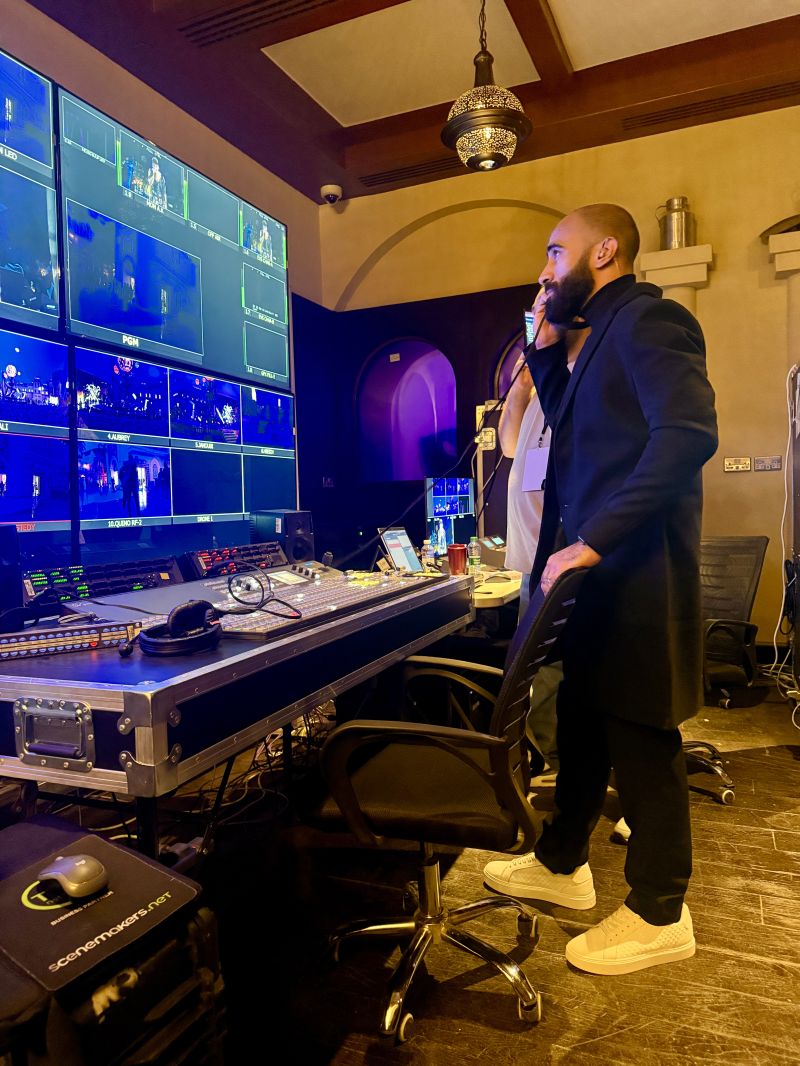
Event Director · UAE
Event direction across the Emirates for government ceremonies, cultural festivals, brand launches and awards. Dubai, Sharjah, Abu Dhabi and Al Ain, with work running into Saudi Arabia. Led by Youssef Akef. Twelve years, two Guinness World Records.
Director, Not Manager
These two titles get used interchangeably and they are not the same job. An event manager is responsible for the event happening: suppliers, schedule, budget, permits, safety, delivery. An event director is responsible for what the event means and how it lands: the idea, the narrative, the design, the content, and the show call on the night.
On a small brand event one person reasonably does both. On a government ceremony with a head of state in the front row, or a festival running fourteen days across a public site, they are separate jobs pointed at the same date. If you are hiring and unsure which you need, the question to ask is whether your problem is that the event might not happen, or that it might happen and mean nothing.
Types of Event
- Government ceremonies and official openings. Protocol, precedence, bilingual scripting, broadcast-grade content, and a run of show that survives a last-minute change to the guest list.
- Cultural festivals. Multi-day, multi-audience, public. The design problem is a visitor journey that works for a family at ten in the morning and a dignitary at eight at night.
- Brand launches and activations. One idea, expressed in space, that photographs well and still makes sense to someone standing in it.
- Awards shows. Pace, rhythm and dignity. Long lists of names are the enemy of attention, and the structure has to solve that.
- Record attempts. A public Guinness World Record attempt is an event with an adjudicator in it. The event has to work whether or not the record falls.
What Makes UAE Events Different
Directing here is not the same as directing in Europe or the US, and the differences are practical rather than cosmetic.
Bilingual by default. Most government and cultural work runs in Arabic and English together. That is not a translation task bolted on at the end. It changes script length, host casting, screen layout, subtitle timing and the run of show. Arabic sets right to left, which affects how content is composed, not just how it reads.
Protocol is a design constraint. Where people sit, who is named, what order things happen in and how long a segment can run are often fixed before the creative starts. Good work treats that as material rather than an obstacle.
The calendar rules. Ramadan, National Day, Eid and the summer heat compress the usable year. Outdoor work concentrates into a season, which means the good suppliers and the good sites are competed for, and late briefs pay for it twice.
Approvals take real time. Permits and content approvals across different emirates run to different clocks. Sharjah, Dubai and Abu Dhabi each have their own bodies and expectations. A schedule that ignores this is fiction.
How a Project Runs
- Brief and interrogation. What the client asked for, what the audience will actually feel, and where those two diverge.
- Concept. One idea, written plainly enough that a minister, a sponsor and a rigger all picture the same thing.
- Design and direction. Run of show, stage and spatial design, screen content, script, music, talent, all designed against the concept.
- Production. Working with technical and production teams so the idea survives load-in, budget and site reality.
- Show call. On headset, calling it live. The idea is only real on the night.
Selected Events
- Six Flags Qiddiya City Opening · 2024
- Al Ain Zoo Conservation Festival · 2024
- Al Ain Flower Festival · Guinness World Record
- ADEK Awards · Abu Dhabi · 2025
- MBRIF Launch
Recognition
- Two-time Guinness World Record holder
- UAE Golden Visa · Creative Category
- MESE Young Achiever Nominee · 2018, 2019, 2025
Common Questions
What does an event director do?
An event director owns the idea and the audience experience: the concept, the run of show, the stage and spatial design, the screen content, the script and the music, and on the night the show call itself. It is distinct from an event manager, who owns logistics, budget, suppliers, permits and delivery.
What is the difference between an event director and an event manager in Dubai?
The event manager makes the event happen. The event director decides what it means and how it feels. A manager is measured on delivery, budget and safety. A director is measured on whether the audience understood and remembered the thing.
What kinds of events do you direct in the UAE?
Government ceremonies and official openings, cultural festivals, brand launches and activations, awards shows, and public record attempts.
Do you work in Sharjah and Abu Dhabi as well as Dubai?
Yes. Projects have run in Dubai, Sharjah, Abu Dhabi and Al Ain. Each emirate has its own permitting bodies, cultural expectations and approval timelines, and those differences shape the schedule from the first week.
How far in advance should a UAE event be booked?
Three to six months for a festival or a ceremony. Government and cultural work needs approval cycles built into the timeline, and concept has to be settled before production locks.
Can you run an event in both Arabic and English?
Yes. Most UAE government and cultural events run bilingually. That affects script, subtitling, screen layout, host casting and the run of show, and it is designed in from the start rather than translated at the end.
Have you delivered Guinness World Record attempts?
Two, both in Al Ain. The largest flower bouquet at the Al Ain Flower Festival and the largest palm leaf sentence at the Al Ain Zoo Conservation Festival.
Related: Creative Director in Dubai · Film Director in Dubai · Case studies
Start a Project